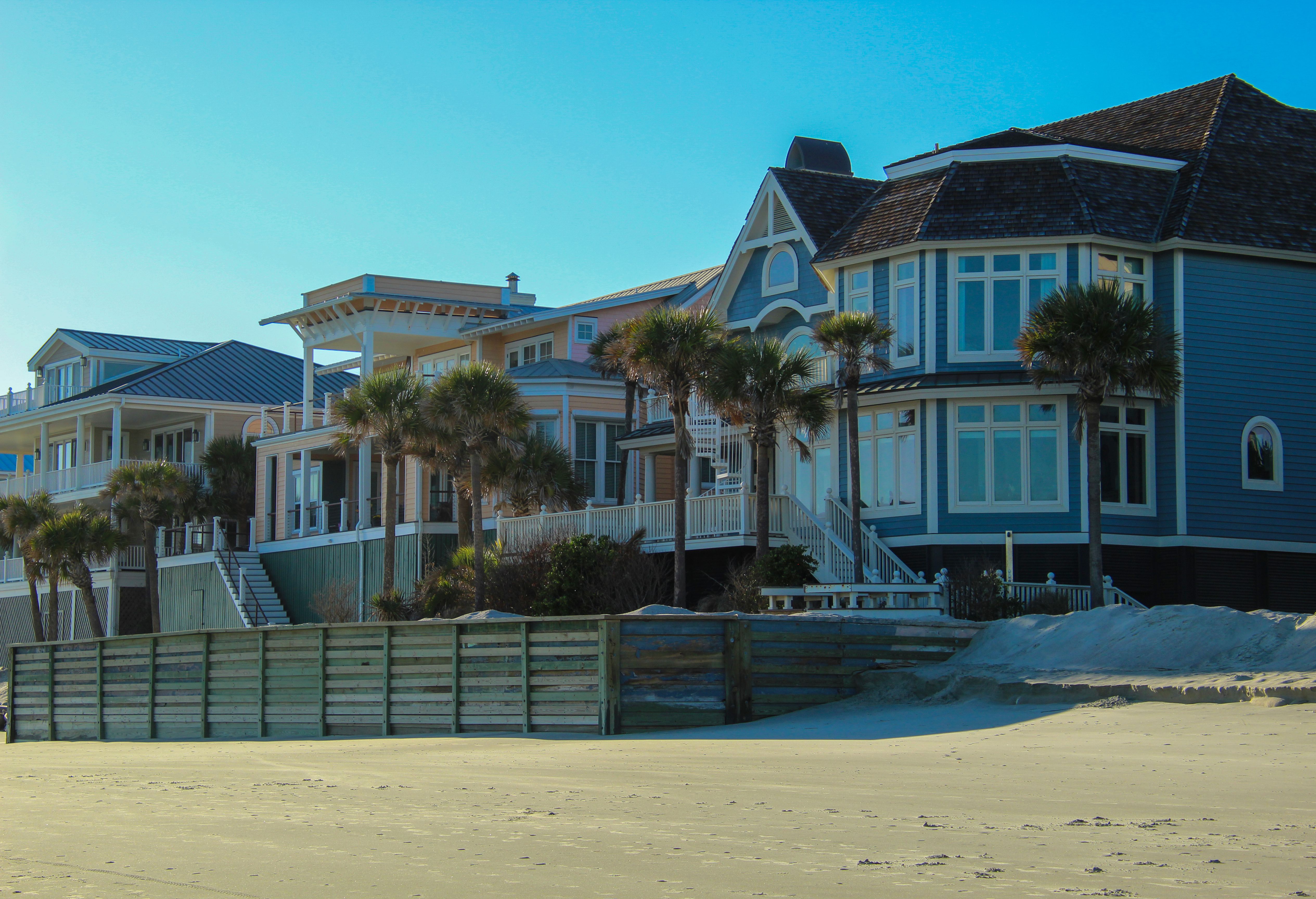
Buying a Second Home or Vacation Home in Charleston
Buying a Second Home or Vacation Home in Charleston
Thousands of buyers are drawn to the idea of owning a second home in Charleston — imagining weekend escapes to the Lowcountry, rental income from a luxury beach property, or an investment that appreciates over time. But the reality of owning a second home here is far more regulated and financially complex than many realize. Leah Beaulieu and BJ Rodgers with Coast2Coast Properties help buyers navigate this decision every year, and they'll tell you straight: a second home in Charleston works brilliantly for some buyers and creates financial regret for others.
The short answer
- Whole-house short-term rentals are banned in Charleston — you can only rent your primary residence while you're living there, not a separate vacation home
- HOA restrictions kill many vacation rental plans — even if the city allows it, your HOA probably doesn't
- Investment rental properties are taxed at 6% vs. 4% for primary residences, plus state income tax on rental proceeds and short-term rental taxes of 12.5% (6% sales tax + 1–3% accommodations tax)
- Property management costs 20–30% of gross rental income, cutting projected returns significantly
- Kiawah Island, Mount Pleasant, and barrier islands see the strongest rental demand, but they also carry flood insurance costs and hurricane risk
- Pure investment returns are modest — most second-home investors break even on annual cash flow and rely on long-term appreciation
- Lifestyle is often the real reason owners keep these properties, not income
Is a vacation home in Charleston worth it as an investment?
That depends entirely on your definition of "investment." If you're expecting consistent positive cash flow and strong ROI, the Charleston second-home market will disappoint you. If you're buying a lifestyle property that happens to generate modest income in off-season, you'll likely be happy.
Here's the math: A $600,000 vacation home in a managed community like Kiawah Island 29455 might generate $45,000–$55,000 in gross rental income during high season and shoulder months. That sounds promising until you account for property management (20–30%, or $9,000–$16,500), short-term rental taxes (12.5%, or $5,625–$6,875), property taxes (6% assessment rate on investment property, approximately $3,600), homeowner's insurance ($1,200–$2,000), maintenance and repairs (budget 1–2% of property value annually, $6,000–$12,000), and HOA fees (Kiawah averages $8,000–$12,000 annually). You're looking at $33,000–$50,000 in annual expenses against $45,000–$55,000 in gross income — leaving you with minimal positive cash flow or even a loss in slower years.
The appeal of second-home investing in Charleston is not cash flow; it's appreciation. Charleston's real estate market has appreciated 5–7% annually over the past decade, outpacing inflation and national averages. If you're buying a second home assuming that long-term appreciation will be your real return, that's a reasonable bet. If you're counting on rental income to offset your costs in the near term, you'll be surprised and disappointed.
Charleston's vacation rental regulations: What you can and cannot do
This is where many buyers get blindsided. Charleston's short-term rental market is heavily restricted compared to other coastal cities.
The fundamental rule: Whole-house short-term rentals (30 days or fewer) are banned in Charleston proper. You can only operate a short-term rental if you are owner-occupied — meaning you're living there during the guest stays. This eliminates the entire "buy a beach house, list it on Airbnb, and rent it out year-round" fantasy.
Owner-occupied rentals still require a permit. You must apply through the city's Department of Livability and Tourism. Some neighborhoods allow owner-occupied STRs; others have stricter zoning classifications that prohibit them altogether. And some blocks have caps on how many permits are issued — if the block is full, you're out of luck even if your HOA allows it.
Gated communities and HOA areas have their own rules. Kiawah Island 29455 and Seabrook Island allow vacation rentals but with management company requirements and registration procedures. Daniel Island 29492 restrictions vary by section. Some HOAs in Mount Pleasant 29464/29466 and Summerville 29483/29485 prohibit rentals altogether, while others permit them with restrictions on occupancy limits, parking, and noise. Always check with the HOA before buying — some properties that appear rentable are actually blocked by their own governing documents.
Repeat violations are expensive. Zoning, parking, or noise violations can result in fines up to $500 per incident under Charleston's three-strike rule. After three violations in a year, enforcement escalates quickly.
The net result: You cannot reliably own a second home in Charleston and rent it consistently like you might in other markets. The market is designed to prioritize owner-occupancy and neighborhood stability over investor cash flow.
Tax treatment: Primary residence vs. investment property
The tax differences between a primary residence and an investment property add up fast, and most second-home buyers don't understand them fully until after closing.
Property tax: South Carolina assesses primary residences at 4% of market value; investment properties at 6%. On a $600,000 property, that's an extra $1,200 per year in property tax (6% minus 4% on $600K). Annually, that compounds.
State income tax: Rental income from your vacation home is taxed as ordinary income at South Carolina's graduated rates (0% to 6.2% depending on your income bracket). Most landlords fall into the 4–6% bracket. Add federal income tax (10–37% depending on your overall income), and your combined marginal tax rate on rental income is likely 25–35%. If you generate $20,000 in net rental income, you'll pay $5,000–$7,000 in federal and state income taxes.
Short-term rental taxes: If you operate as an STR (owner-occupied or otherwise), South Carolina applies a 6% sales tax on rental income plus a 1–3% accommodations tax. Combined, that's typically 7–9% on top of state income tax. Kiawah Island's accommodations tax sits at 3%, making the total combined short-term tax burden approximately 12.5%.
Mortgage interest deduction: You can deduct mortgage interest on a second home, which provides some offset — but only on loans up to $750,000 combined across all properties (changed by the Tax Cuts and Jobs Act). This helps, but doesn't eliminate the tax burden.
The net effect: A $600,000 vacation home generates significant tax obligations that a primary residence doesn't, reducing your net returns.
Property management, cleaning, and operating costs
If you're not on-site full-time to manage the property, you'll need to hire it out. This is where projected income meets reality.
Property management companies take 20–30% of gross rental income. For a property generating $50,000 annually, that's $10,000–$15,000 going straight to the property manager. They handle bookings, guest communication, turnover coordination, and compliance — valuable work, but it cuts into your bottom line significantly.
Cleaning, linens, and turnover costs. Between guests, the property needs professional cleaning ($150–$300 per turnover), fresh linens, and inspections. With high-season properties that turn over 2–3 times per week in July and August, cleaning costs alone run $3,000–$5,000 monthly.
Maintenance and repairs. Vacation properties experience heavy wear. HVAC systems run continuously in summer; plumbing gets stressed; furnishings take abuse. Budget 1–2% of property value annually ($6,000–$12,000 on a $600,000 home) for maintenance you'll definitely need.
HOA fees in managed communities. Kiawah Island, Seabrook Island, and similar gated communities charge substantial HOA fees ($8,000–$15,000 annually) that don't go toward property management — they're just the cost of belonging to the community.
Insurance and licenses. Vacation rental insurance differs from standard homeowners policies and costs $1,500–$3,000 annually depending on coverage. You'll also need proper permits and registrations with the city and possibly the Accommodations Tax Bureau.
Adding it all up, your operating costs easily consume 50–70% of gross rental income before you account for taxes or mortgage interest.
Where vacation rental income is strongest in the Charleston area
If you're still convinced that a second home in Charleston makes sense, some locations perform better than others.
Kiawah Island 29455 sees the strongest rental demand among luxury properties. The private golf course, Cassique resort amenities, and island prestige attract renters willing to pay premium rates ($200–$400/night in season). But Kiawah also carries the highest HOA costs, flood zone exposure, and purchase prices ($1M–$5M+). Your rental income is highest here, but so are your total expenses.
Mount Pleasant 29464/29466, particularly near Shem Creek with water views, generates consistent rental income for townhomes and condos in the $400K–$800K range. Shem Creek homes attract fishing and boating enthusiasts who return repeatedly. Mount Pleasant's rental market is more forgiving than the barrier islands, with lower HOA costs and less weather exposure.
Barrier islands (Isle of Palms 29451, Sullivan's Island 29482, Folly Beach 29439) have strong summer demand but severe off-season downturns. Hurricane season (June–November) creates cancellations and nervous renters. Flood insurance costs are brutal in AE zones. Income is highly seasonal.
Johns Island 29455 and James Island 29412 offer more affordable entry points ($400K–$600K) and lower HOA costs, but rental demand is softer — renters prefer the prestige of Kiawah or the beach access of barrier islands.
Summerville 29483/29485/29486 has minimal STR rental culture outside of new construction communities. Most buyers here are owner-occupants, not investors.
Leah Beaulieu and BJ Rodgers often point out that the strongest "returns" from a second home in Charleston come from lifestyle enjoyment and appreciation, not from rental income alone.
The biggest mistake second-home buyers make
The biggest mistake is buying a second home with the primary financial expectation that rental income will offset its costs. Buyers see a $600,000 property, calculate $50,000 in potential rental income, and think "that covers my mortgage and some of my expenses." Then they discover property taxes, HOA fees, management costs, repairs, insurance, and regulatory restrictions, and suddenly the property is cash flow-negative every year.
The second biggest mistake is not reading the HOA documents before buying. Buyers fall in love with a property, make an offer, and only discover at inspection that the HOA prohibits short-term rentals or limits rental periods to 90+ days, making the STR plan impossible. By then, they're committed to a non-investable property.
A third mistake is assuming Charleston's STR rules are like other coastal markets. In some markets, you can buy a house, list it on Airbnb full-time, and run it like a mini-hotel. In Charleston, you can't. Understanding this up front saves months of frustration.
A realistic example
Meet Mark and Jennifer, a couple from Virginia who visited Charleston for a wedding, fell in love with the city, and decided to buy a vacation home. They found a beautiful 4-bedroom townhome on Shem Creek in Mount Pleasant (29464) listed at $685,000 with ocean views and a private dock slip. It was perfect.
They calculated: "If we rent it for $250 a night during May–September (150 days), that's $37,500 annually. Even covering costs, it should roughly break even, and we'll enjoy it during the off-season."
Here's what actually happened:
Gross rental income: $37,500 (if fully booked — which never happens)
Property management (25%): -$9,375
Short-term rental taxes (12.5%): -$4,687
Property taxes on $685K at 6%: -$4,110
Homeowners insurance: -$2,000
HOA fees (Shem Creek community): -$8,500
Maintenance/repairs (1%): -$6,850
Mortgage interest (first year, ~$24K/year): -$24,000
Can't deduct fully against rental income: ~-$5,000 (partial deduction allowed)
Total operating costs: ~$64,522
Net cash flow: -$27,022 annually
Mark and Jennifer expected break-even; instead, they're writing a $27,000 check every year just to own the property. They found out the hard way that "fully booked" is marketing fiction — real occupancy runs 40–50% in shoulder months — and even strong months have cancellations.
They kept the property anyway because they genuinely loved using it themselves during autumn and winter. But they stopped thinking of it as an investment. It's a lifestyle purchase that costs them $27,000 annually, and they've made peace with that. If it appreciates 6% annually on a $685,000 purchase, that's about $41,000 in appreciation — which theoretically covers the annual loss and then some. But that appreciation is theoretical, and the annual loss is very real.
So what about buying a second home in Charleston?
If you're considering a second home in Charleston, ask yourself these key questions:
- Can you afford this property even if rental income is zero? If not, it's not an investment — it's a liability you can't support.
- Do you genuinely want to use it yourself, not just as a rental machine? The best second-home owners love their properties for personal use and accept that rental income is a bonus, not a plan.
- Have you verified that the specific HOA allows short-term rentals? Don't assume — call the HOA directly and read the covenants.
- Are you buying for long-term appreciation or short-term cash flow? Charleston appreciates well if you hold for 5+ years, but doesn't generate strong annual income.
- Is this property in a flood zone? Barrier islands and waterfront properties have brutal flood insurance costs that make cash flow even worse. Verify your flood zone and insurance cost before committing.
FAQ: Second homes and vacation rentals in Charleston
Can I rent out my vacation home full-time, like an Airbnb?
Not in Charleston proper. Whole-house short-term rentals are banned unless you're owner-occupied. You can rent to guests only when you're physically present in the home. Some gated communities like Kiawah Island 29455 allow professional rental management, but you still can't list it full-time on Airbnb without living there.
What's the difference between a second home and an investment property for tax purposes?
A second home (primary residence is elsewhere) is assessed at 6% on its property value and generates income subject to state income tax. A rental property receives even harsher treatment. Essentially, owning a second home in South Carolina means paying higher property taxes and income taxes on any rental revenue.
Can I deduct my mortgage interest and property taxes if I rent out the property part-time?
Partially. If the property qualifies as a second home (used personally some of the time), you can deduct mortgage interest and property taxes on Schedule A. But once rental income exceeds personal use days, the IRS reclassifies it, and deductions become much more limited. Consult a tax professional for your specific situation.
How much can I expect to earn renting a second home in Mount Pleasant 29464?
Realistically, $25,000–$40,000 annually in gross rental income for properties in the $400K–$700K range, assuming 50–60% occupancy and $150–$250/night rates. After all costs (management, taxes, insurance, HOA, maintenance), you're likely to break even or lose money annually, with any profit coming from long-term appreciation.
What happens if my vacation home is damaged by a hurricane?
Your homeowners insurance covers standard damage. If the property is in an AE flood zone, standard homeowners doesn't cover flood — you need separate flood insurance, which can cost $2,000–$5,000+ annually on a vacation property. After a major hurricane, your flood insurance will spike, and you may face a waiting period before it renews if you've filed claims.
Is it better to buy a second home in Kiawah Island 29455 or Mount Pleasant 29464?
Kiawah commands higher rental rates but costs far more ($1M+ vs. $400K–$800K), carries higher HOA fees, and has greater flood risk. Mount Pleasant offers better affordability and rental accessibility. For pure cash flow, neither works great. For lifestyle, Kiawah is exclusive; Mount Pleasant is more practical.
Can I buy a second home right now and see strong appreciation?
Historically, yes — Charleston's market has appreciated 5–7% annually for over a decade. But no market appreciates in a straight line. If you can't hold for at least 5 years, second-home appreciation may not overcome your annual carrying costs.
What if I buy a second home and never rent it out?
Then it's purely a lifestyle purchase, and you should evaluate it as such. You'll avoid the complications of STR regulations and rental income taxes. However, you'll still pay 6% property taxes (instead of 4% on a primary residence), HOA fees, insurance, and maintenance. A fully personal second home is a luxury that costs what it costs.
Final answer
Buying a second home or vacation home in Charleston can make sense — but not for the reasons most buyers think. Strong rental income is a mirage in this market because of regulations, operating costs, and taxes. Kiawah Island, Mount Pleasant, barrier islands, and Johns Island all have vacation rental markets, but none deliver the 8–12% annual cash-on-cash returns many buyers expect when they start shopping.
What Charleston does offer is long-term appreciation, a genuinely enjoyable lifestyle for part-time residents, and a strong market for buyers who can afford to own property without relying on rental income. If you're buying a second home in Charleston because you love the place and can comfortably carry it even if renters never materialize, you'll likely be happy. Leah Beaulieu and BJ Rodgers see this work beautifully for owners who prioritize lifestyle over income.
If you're buying primarily to generate cash flow or replace your mortgage payment with rental income, you'll be disappointed. The Charleston second-home market rewards long-term owners with appreciation and personal enjoyment, not monthly rental checks. Make sure you're buying for the right reason.
Ready to explore second-home options in Charleston? They can help you find the right location, understand the real financial picture, and avoid costly mistakes that derail second-home dreams.
About Leah Beaulieu & BJ Rodgers — Coast2Coast Properties
Leah Beaulieu and BJ Rodgers are Charleston, South Carolina real estate professionals with Coast2Coast Properties, helping buyers compare neighborhoods, understand local market differences, and find the right fit across the Charleston area. Whether you are buying your first home, relocating to the Lowcountry, or looking for investment opportunities, Leah and BJ bring local knowledge, straight talk, and a genuine commitment to helping clients make smart decisions.
Coast2Coast Properties
www.coast2coastprop.com
843-697-1409 / 803-201-4259