Charleston Buyer Reality Check: The Commute Can Change Everything
Charleston Buyer Reality Check: The Commute Can Change Everything
Of all the things that surprise buyers after they move to the Charleston area, traffic is near the top of the list. Not because Charleston is gridlocked in the way of Atlanta or Washington, D.C. — it isn't. But because the geography, growth, and limited infrastructure of the metro create pinch points that can turn a 15-mile drive into a 50-minute ordeal. Leah Beaulieu and BJ Rodgers with Coast2Coast Properties consistently tell buyers: before you fall in love with a neighborhood, drive the route at rush hour.
The short answer
- Charleston's peninsula geography means almost every inbound commute crosses a bridge — and bridge chokepoints can't be bypassed
- The Ravenel Bridge (US-17) from Mount Pleasant is one of the most congested crossings in the metro — plan 25 to 45 minutes during rush hour
- I-26 from North Charleston and Summerville is one of the most congested highway segments in South Carolina
- US-17 South through West Ashley and past the Cosco Busan Bridge can slow to a crawl during morning peak hours
- Maybank Highway on Johns Island 29455 has no alternate route — if it backs up, you wait
- The I-526 Mark Clark Expressway helps connect suburbs to each other but doesn't reach the peninsula
- Buyers who pick a neighborhood without driving the commute often regret it within 90 days of moving
Why Charleston Traffic Is Different From Most Markets
The City of Charleston sits on a peninsula. Water borders it on three sides. That single geographic fact shapes the entire traffic situation in the metro, because every residential suburb feeds into a limited number of crossings.
There is no grid of roads leading into downtown from multiple directions. There are bridges — and when a bridge backs up, there is no alternate route. This is not a problem a new highway or additional lane can fully solve; the land simply doesn't permit it.
The metro has grown faster than its road infrastructure. The population of the Charleston–North Charleston metro area has grown by more than 30% in the last decade. New residential communities continue to open in Summerville, Goose Creek, and outer Johns Island — but the primary corridors those communities feed into (I-26, US-17, and Maybank Highway) haven't expanded proportionally.
The result: a traffic experience that is intermittently excellent and intermittently maddening, depending on the time of day, day of the week, weather, tourist season, and whether anything has gone sideways on the bridge.
The Key Corridors and What to Expect
The Ravenel Bridge (US-17) — Mount Pleasant to Downtown
The Arthur Ravenel Jr. Bridge is the primary crossing between Mount Pleasant (29464/29466) and downtown Charleston (29401). It's a single span in each direction. When it flows, the crossing takes 5 to 8 minutes. When it doesn't, it can take 30 to 45 minutes just to cross the bridge, with backups stretching deep into the surface streets on both sides.
Morning rush: 7:00 a.m. to 9:00 a.m., Mount Pleasant to downtown — allow 25 to 45 minutes.
Evening rush: 4:30 p.m. to 6:30 p.m., downtown to Mount Pleasant — allow 30 to 50 minutes.
There is no alternate crossing. If there is an accident on the Ravenel, traffic has nowhere to go.
I-26 — Summerville, Goose Creek, and North Charleston to Downtown
I-26 is the main artery connecting the inland suburbs to the peninsula. It's regularly cited as one of the most congested highway segments in South Carolina. The stretch between I-526 and the Crosstown into downtown is particularly backed up during peak hours.
From Summerville 29483 to downtown: 45 to 65 minutes during morning rush, depending on which end of Summerville you're starting from.
From Summerville 29486 (Nexton, Cane Bay): Often 60 to 75 minutes. These communities sit in northern Summerville, adding another 10 to 15 minutes before you're even on I-26.
From Goose Creek 29445: 35 to 55 minutes to downtown via I-26.
From North Charleston 29405/29406: 20 to 35 minutes to downtown, with significant variability depending on your specific starting point and the interchange traffic.
US-17 South — West Ashley to Downtown
West Ashley (29407/29414) connects to downtown via US-17 or the James Island Connector. The US-17 route through the Cosco Busan Bridge area can back up significantly. The James Island Connector (SC-30) is faster in many conditions but merges onto Folly Road, which has its own congestion.
From West Ashley 29407 to downtown: 20 to 35 minutes during rush hour.
From outer West Ashley or the Bees Ferry Road corridor (29414): 30 to 45 minutes.
Maybank Highway — Johns Island to Everywhere
Johns Island 29455 is a single-point-of-failure situation. Maybank Highway is the primary road off the island. There is no alternate route. During morning rush hour and school pickup, Maybank backs up significantly — and the congestion has worsened as Johns Island has grown rapidly in popularity and development.
From inner Johns Island to James Island or downtown: 25 to 40 minutes in rush hour.
From outer Johns Island (near Kiawah/Seabrook gateway): 40 to 60 minutes or more.
This isn't a knock on Johns Island — it's a beautiful community and many buyers love it. But the road situation is real and worth factoring in before you commit.
I-526 — The Mark Clark Expressway
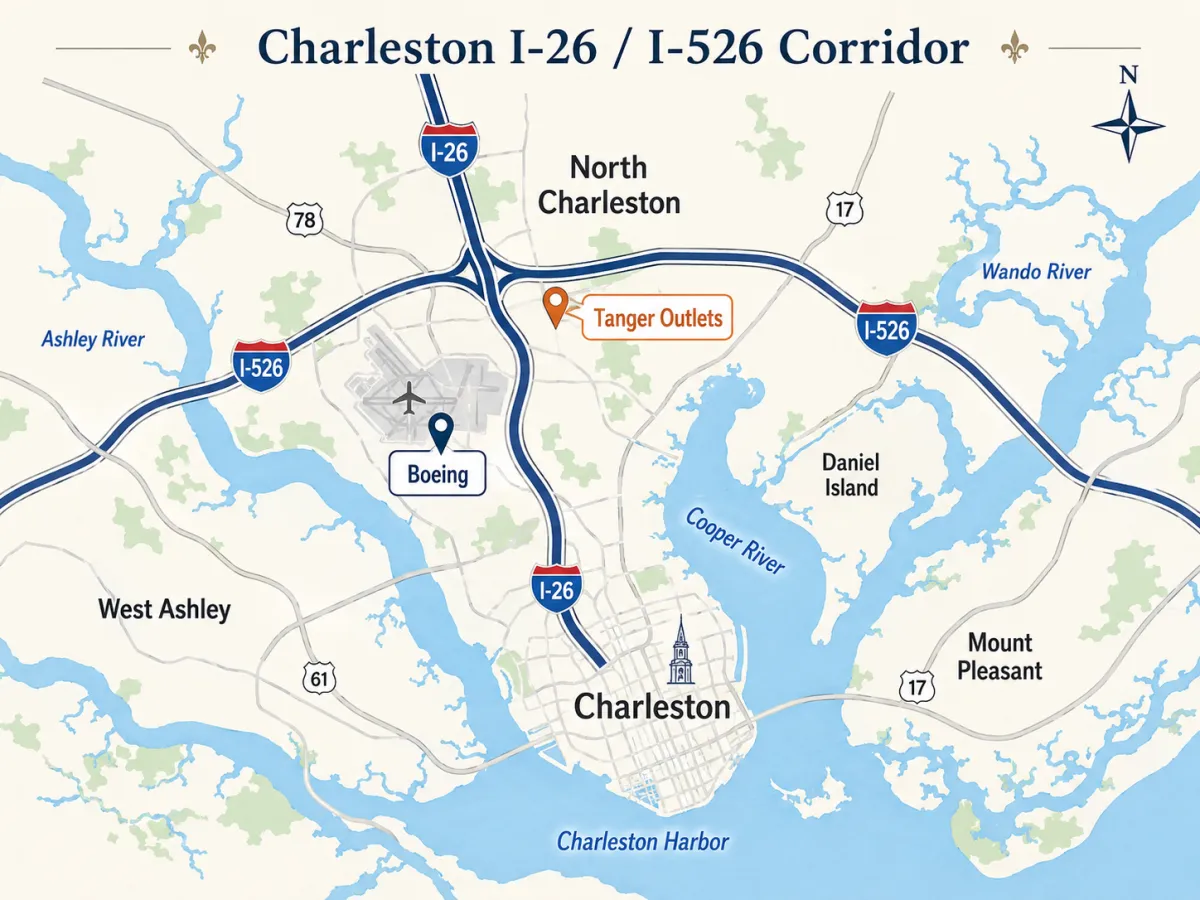
I-526 loops around the metro connecting the airport, North Charleston, Summerville entry points, Mount Pleasant, and West Ashley. It is a useful connector for cross-county travel but does not cross the peninsula. Its western terminus at I-26 and its eastern connections in Mount Pleasant are both known congestion spots.
For buyers working at the airport, Boeing, Joint Base Charleston, or along the North Charleston employment corridor, I-526 is the backbone of the commute. For buyers trying to reach downtown, it's a segment of the trip — not the whole solution.
Major Employers and Where to Live
Where you work determines which geographic zone makes sense. Here's a quick map:
Working downtown (Medical University of South Carolina, law firms, restaurants, city government, Roper St. Francis on Calhoun):
- Best positioned: James Island 29412, close-in West Ashley 29407, inner North Charleston
- Workable: Mount Pleasant 29464 (bridge dependent), outer West Ashley 29407/29414
- Long commute: Summerville, Goose Creek, Johns Island
Working at Joint Base Charleston / North Charleston corridor:
- Best positioned: Hanahan 29410, North Charleston 29405/29406, Goose Creek 29445
- Workable: Summerville 29483/29485 via I-26
- Long commute: Mount Pleasant, downtown, outer Johns Island
Working at Boeing (North Charleston):
- Best positioned: North Charleston 29406, Hanahan 29410, Goose Creek 29445, inner Summerville 29483
- Workable: Mount Pleasant via I-526
- Long commute: James Island, outer West Ashley, Johns Island
Working on Daniel Island 29492:
- Best positioned: Daniel Island itself (if you can afford it), North Charleston near I-526
- Workable: Mount Pleasant 29464, inner Goose Creek
- Long commute: West Ashley, James Island, Summerville
Working in Mount Pleasant:
- Best positioned: Mount Pleasant 29464/29466, Daniel Island 29492
- Workable: North Charleston via I-526
- Long commute: Summerville, Goose Creek, Johns Island, West Ashley
The Biggest Mistake Buyers Make About the Commute
Buyers frequently look up their commute on Google Maps during the search process — but they do it at noon on a Saturday. The result looks great: 20 minutes, no problem. The reality at 7:45 a.m. on a Tuesday is a different number.
Leah Beaulieu and BJ Rodgers advise every commute-sensitive buyer to drive the actual route — at the actual time — before finalizing their neighborhood search. Not a rough sense of the area, not a Maps estimate. A real drive from the address of a home they're seriously considering to the front door of their workplace, during the time they'd actually be doing it.
The buyers who do this test drive often come back having revised their neighborhood priorities. A buyer who liked Summerville 29486 for the new construction and amenities might recalibrate to North Charleston 29406 or Goose Creek 29445 after experiencing the actual drive to their employer on I-26.
A Realistic Example
A project manager relocating from Richmond, Virginia takes a remote-first job but needs to be in downtown Charleston three days a week. She finds a new construction home in Cane Bay Plantation (Summerville 29486) for $385,000 — a great price for a well-equipped home in a beautiful community with a resort pool.
She drives the route on a Monday morning in January. It takes 67 minutes.
She checks Redfin for West Ashley homes in the $400,000 to $425,000 range. She finds a 3-bedroom near Avondale. She drives that route to downtown: 22 minutes.
The West Ashley home costs $35,000 more. But at three days per week, 52 weeks a year, the Summerville commute costs her roughly 390 additional hours per year in the car. That's nearly 10 full work weeks. The calculus shifts.
She buys in West Ashley. Six months later, she tells Leah and BJ it was the best decision she made in the whole process.
So, what should buyers know about Charleston commutes?
- Test the actual drive: Google Maps at noon ≠ your commute at 7:45 a.m.
- Account for bridge risk: If your route crosses the Ravenel Bridge or relies on a single crossing, you have no alternate when it backs up
- Match neighborhood to employer: The "affordable" suburb 35 miles out might cost you 400 hours a year
- Factor in school traffic: School zones on Maybank Highway, US-17, and the connector add meaningful time during the school year
- Consider off-peak flexibility: If your job allows flex hours or remote work days, your commute calculus changes significantly
- I-526 is not downtown: It connects the suburbs to each other and to North Charleston — not to the peninsula
FAQ
How bad is traffic in Charleston, SC?
Traffic in Charleston is moderate by major-metro standards but can be genuinely bad during rush hours, particularly on bridge crossings, I-26 between Summerville and downtown, and US-17 corridors. The metro's growth has outpaced infrastructure investment on several key corridors, and the peninsula's geography means bridge chokepoints are unavoidable for anyone commuting downtown.
What is rush hour like in Charleston?
Morning rush runs from approximately 7:00 a.m. to 9:00 a.m., with peak congestion often between 7:30 and 8:30 a.m. Evening rush runs from 4:30 p.m. to 6:30 p.m. Bridge crossings — particularly the Ravenel Bridge from Mount Pleasant — are the most congested points. School zone traffic adds significant time on roads like Maybank Highway (Johns Island), US-17A (Summerville), and the connector from James Island between 7:00 and 8:30 a.m.
Is Summerville far from downtown Charleston?
Summerville is 27 to 35 miles from downtown Charleston depending on the specific community. Rush-hour commutes from most parts of Summerville to the downtown peninsula run 45 to 65 minutes, with the newer northern communities (Nexton, Cane Bay in 29486) often taking 60 to 75 minutes. Off-peak, the drive runs 35 to 50 minutes. Many buyers who do it daily describe it as manageable; buyers doing it five days a week typically find it exhausting after 6 to 12 months.
What is the Ravenel Bridge and why does it affect commutes?
The Arthur Ravenel Jr. Bridge (US-17) is the primary crossing between Mount Pleasant and downtown Charleston over the Cooper River. It's a cable-stayed bridge with two lanes in each direction. During rush hour, backup approaches from both sides — particularly from the Mount Pleasant side in the morning — can add 20 to 40 minutes to a commute. It is the only vehicle bridge crossing between Mount Pleasant and downtown, meaning there is no alternate route when it backs up.
Which Charleston suburb has the shortest commute to downtown?
James Island (29412) and close-in West Ashley (29407) consistently offer the shortest commutes to downtown for buyers who don't want to live on the peninsula itself. Most James Island addresses are within 5 to 8 miles of downtown via the James Island Connector or Folly Road, with rush-hour commutes of 15 to 25 minutes. Prices reflect that advantage.
How long does it take to drive from Goose Creek to Charleston?
From most Goose Creek (29445) addresses, morning rush-hour commutes to downtown Charleston via I-26 run 35 to 55 minutes. Off-peak, the drive is 25 to 40 minutes. Goose Creek is better positioned for commutes to Joint Base Charleston, the North Charleston employment corridor, and the airport than for daily trips to the downtown peninsula.
Is I-526 helpful for commuting to downtown Charleston?
I-526 (the Mark Clark Expressway) is useful for cross-metro travel — connecting Mount Pleasant, the airport, North Charleston, and West Ashley — but it does not reach the downtown peninsula. Most commuters coming from North Charleston, Goose Creek, or Summerville still end up on I-26 to reach downtown, and the merge from I-526 onto I-26 is itself a congestion point. For workers along the North Charleston/airport corridor, I-526 is the backbone of the commute.
What can I do to research my commute before buying?
Drive it. Literally get in your car at the time you would normally leave for work, from the address you're considering, and drive to your workplace. Do it twice — morning and evening. GPS estimates at off-peak hours are not reliable predictors of your actual daily experience. Many buyers find that this single step changes their neighborhood priorities more than any amount of online research.
Final Answer
The Charleston metro is a wonderful place to live, and the commute for many buyers is completely manageable — with the right neighborhood choice. The ones who struggle are the buyers who chose based on price and listing photos without accounting for the bridge geometry, I-26 congestion, or the reality of Maybank Highway at 8 a.m. Leah Beaulieu and BJ Rodgers with Coast2Coast Properties build commute reality into every buyer conversation — because where you live and where you work need to make sense together, or nothing else does.
About Leah Beaulieu & BJ Rodgers — Coast2Coast Properties
Leah Beaulieu and BJ Rodgers are Charleston, South Carolina real estate professionals with Coast2Coast Properties, helping buyers compare neighborhoods, understand local market differences, and find the right fit across the Charleston area. Whether you are buying your first home, relocating to the Lowcountry, or looking for investment opportunities, Leah and BJ bring local knowledge, straight talk, and a genuine commitment to helping clients make smart decisions.
Coast2Coast Properties
www.coast2coastprop.com
843-697-1409 / 803-201-4259