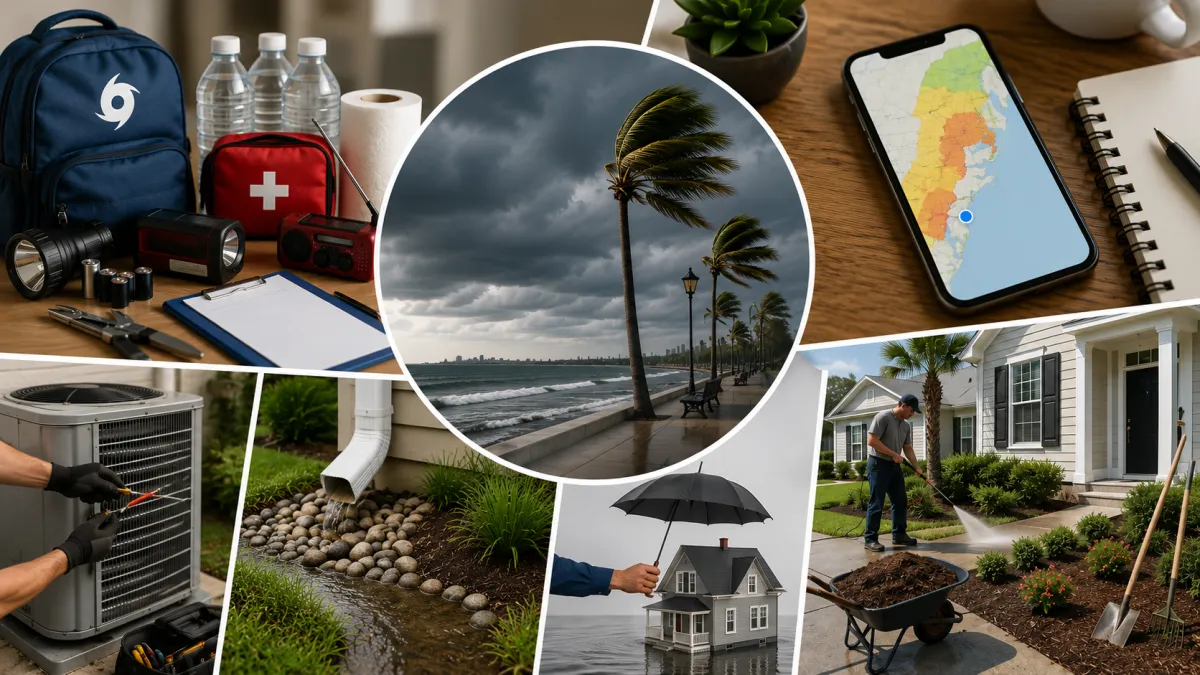
How Often Does Charleston Actually Get Hit by Hurricanes?
How Often Does Charleston Actually Get Hit by Hurricanes?
When you ask a realtor about hurricane risk in Charleston, you get statistics. When you ask a local who's lived here for decades, you get something different: a sense of the odds. "It's rare," they say. "Hugo was 1989. That's a long time ago."
The question "How often does Charleston get hit?" has a simple answer and a more complex one. The simple answer is: not very often. The complex answer involves understanding the difference between a tropical system passing nearby, an actual hurricane strike, and a major hurricane making direct landfall.
The Short Answer
Tropical systems affect South Carolina roughly once every 2.11 years
Actual hurricanes make landfall every 8–9 years on average
Major hurricanes (Category 3+) make direct landfall every 26 years on average
Since 1851 (175 years), only 4 major hurricanes have made direct landfall in South Carolina
The last major direct hit was Hurricane Hugo in 1989—37 years ago
Between 1900 and 2004, 15 hurricanes struck South Carolina directly
Charleston is the most impacted area, with 15 documented landfalls
The Complete Picture: All 45 Tropical Systems Since 1851
To understand how often Charleston actually gets hit, start with the broadest number: 45 tropical cyclones have made landfall on the South Carolina coast since 1851. That's 175 years of hurricane records.
If you divide 45 systems by 175 years, you get an average of one tropical system every 3.9 years. But that number includes everything—tropical depressions, tropical storms, and hurricanes of all strengths. Most are not major threats.
When you narrow it down to actual hurricanes (all categories), the frequency becomes: roughly one hurricane strike every 8–9 years on average. This is still based on the complete 175-year record and includes weak hurricanes that may cause minimal damage.
When you narrow it further to major hurricanes—Category 3, 4, or 5—the frequency drops dramatically: one major hurricane landfall every 26 years on average.
The Four Major Hurricanes: 175 Years, Four Direct Hits
Since 1851, exactly four major hurricanes have made direct landfall on South Carolina:
The Great Charleston Hurricane (1893): This Category 3 storm struck on August 28, 1893, making landfall near McClellanville. It was catastrophic for the era, with winds and storm surge that caused damage equivalent to approximately $282 million in inflation-adjusted 2023 dollars. For Charleston residents of that time, it was devastating. For us 133 years later, it's historical.
Hurricane Hazel (1954): Category 3, making landfall 72 years ago. Most people alive in Charleston today were not born yet.
Hurricane Gracie (1959): Category 3, making landfall 67 years ago. Again, a significant portion of Charleston's current population did not experience this storm.
Hurricane Hugo (1989): The most recent major direct hit. Hurricane Hugo made landfall at Sullivan's Island as a Category 4 storm with maximum sustained winds of 135–140 mph. It produced the highest storm surge ever recorded in South Carolina—approximately 20 feet north of Charleston. Hugo was catastrophic for the region, but it was also 37 years ago.
Four storms in 175 years. That's the real statistic.
What the Absence of a Major Hit Means
Charleston has not experienced a major hurricane (Category 3 or higher) in 37 years. That's nearly four decades of the average 26-year cycle passing without a direct major hit. This is not luck; this is the statistical reality of living in a coastal area. Some years have storms; most years do not.
From a practical standpoint, if you've moved to Charleston in the last 20–30 years, there is a reasonable probability that you have lived your entire time here without experiencing a major hurricane. You have prepared for one every hurricane season, maintained your insurance, and weathered the worry—but the direct threat never materialized.
This is not a guarantee that the next 37 years will be event-free. It's simply a reflection of historical frequency.
Hurricane vs. Tropical Storm: The Frequency Gap
The frequency gap between tropical systems and actual hurricanes is worth noting. You might hear on the news that "a tropical storm is approaching Charleston" several times a decade. A tropical storm is not a hurricane. It has sustained winds of 39–73 mph, versus 74+ mph for a hurricane.
The difference is significant. A tropical storm can cause damage, power outages, and flooding. It requires preparation. But it is categorically different from a hurricane. Between tropical storms and passing systems that miss the coast, Charleston residents experience weather alerts multiple times per season—but actual hurricanes are much rarer.
The 1900–2004 Period: 15 Direct Hits in 104 Years
A more focused look at a known period: between 1900 and 2004, South Carolina experienced 15 hurricane landfalls. That's one every seven years over that 104-year span.
However, this rate is not static. Hurricane activity varies decade by decade. Some periods have clusters of storms; others have long stretches of relative quiet. The 37-year gap since Hugo (1989 to 2026) is a real stretch of quiet—more than one full 26-year average cycle without a major direct hit.
What "Direct Hit" Actually Means
When meteorologists talk about a "direct hit," they mean the eye of the hurricane passes over or very near a location. A hurricane passing 50 miles offshore is not a direct hit, but it can still cause damage, storm surge, and flooding through effects that reach inland.
Between hurricanes that make direct landfall and tropical systems that pass nearby, the frequency of impacts increases. The frequency of major, catastrophic impacts—the kind that cause structural damage and long-term power outages—remains rare.
Looking Forward: Climate and Frequency
There is ongoing research into whether hurricane frequency is changing due to climate change. Some models suggest storms may become less frequent but potentially more intense. However, data on long-term frequency trends remains inconclusive. What is clear is that Charleston's 175-year record shows direct major hits are infrequent events, regardless of recent climate trends.
Preparation remains the same regardless of whether the next major storm is 5 years away or 25 years away: maintain insurance, know your evacuation zone, have supplies, and accept that this is the calculated risk of living in a coastal area.
Charleston Compared to Other Coastal Areas
For context, Charleston's frequency compares reasonably to other desirable coastal cities:
Wilmington, North Carolina: Experiences similar tropical system frequency and has had similar major hurricane strikes historically.
Miami-Dade County, Florida: Experiences far higher hurricane frequency, with multiple major hits in the past 50 years (Andrew in 1992, Irma in 2017).
Gulf Coast (Louisiana, Texas): Experiences more frequent hurricane impacts than Charleston.
Charleston falls in the middle range of Atlantic coastal areas—more exposed than New England, less exposed than South Florida.
The Bottom Line: Rarity, Not Zero
Charleston gets hit by hurricanes infrequently. In a 26-year cycle, you might expect one major direct hit. In the past 37 years, we have had zero. In the next 37 years, the pattern could repeat—low frequency, long stretches without major events.
The frequency is low enough that many residents live their entire Charleston years without experiencing a major direct hit. It is not low enough to ignore—that's why preparation exists. But when someone asks "How often does Charleston actually get hit by hurricanes?" the honest answer is: rarely. The last time was 1989, and the average period between major hits is 26 years.
For a city as desirable as Charleston—with its architecture, community, weather, and lifestyle—infrequent major hurricane strikes is actually a manageable tradeoff. The question isn't really "How often?" It's "Is the lifestyle worth the risk when it does happen?" For most residents who choose to stay, the answer is yes.
Frequently Asked Questions
Q: Does the long gap since Hugo mean we're "due" for a hurricane?
A: No. Hurricane frequency is random; a 37-year gap doesn't increase the odds of an imminent strike. The average is 26 years for major storms, but that doesn't mean one is certain in any particular year.
Q: Are hurricanes getting stronger or more frequent?
A: Research is ongoing. Some climate models suggest fewer but potentially more intense storms. Historic data from Charleston does not show a clear trend in frequency, but this may be changing.
Q: How many hurricanes hit Charleston in the 2020s so far?
A: From 2020–2026, Charleston has not experienced a major direct hit, though tropical systems have passed through the region. The overall trend remains: major hits are rare.
Q: What does "direct hit" mean? Does a hurricane passing 50 miles away count?
A: A direct hit means the eye passes over or very close to the location. A storm 50 miles away is not a direct hit but can still cause storm surge, flooding, and wind damage through indirect effects.
Q: If the average is once every 8–9 years for any hurricane, why haven't we been hit since 1989?
A: Averages average out across long periods. Some decades have more storms; others have fewer. The 1900–2004 period averaged one every 7 years. The 1989–2026 period (so far) has been quiet.
Q: Should I be worried about a hurricane hitting Charleston soon?
A: Based on historical frequency, major direct hits are infrequent. Preparation and insurance are the appropriate response, not constant worry. Most years pass without major storms.
Q: How does Charleston's hurricane risk compare to moving to other regions?
A: Charleston's infrequent major hurricane risk compares favorably to other coastal cities and more favorably than other weather risks in different regions (tornado zones, winter weather regions, wildfire areas).
Final Answer
Charleston gets hit by hurricanes rarely. Since 1851, only four major hurricanes have made direct landfall—an average of one every 26 years. The last one was 37 years ago. Most years pass without significant hurricane impact. When you factor in tropical storms and passing systems, the frequency increases, but direct major hits remain rare.
This rarity—combined with the city's architecture, community, weather, and lifestyle—is why Charleston remains desirable despite hurricane season. The tradeoff is worth it for most residents, as evidenced by the fact that when major direct hits are separated by decades, life goes on, and the community thrives between storms.
About Leah Beaulieu & BJ Rodgers — Coast2Coast Properties
Leah Beaulieu and BJ Rodgers are Charleston, South Carolina real estate professionals with Coast2Coast Properties, helping buyers compare neighborhoods, understand local market differences, and find the right fit across the Charleston area. Whether you are buying your first home, relocating to the Lowcountry, or looking for investment opportunities, Leah and BJ bring local knowledge, straight talk, and a genuine commitment to helping clients make smart decisions.
Coast2Coast Properties
www.coast2coastprop.com
843-697-1409 / 803-201-4259