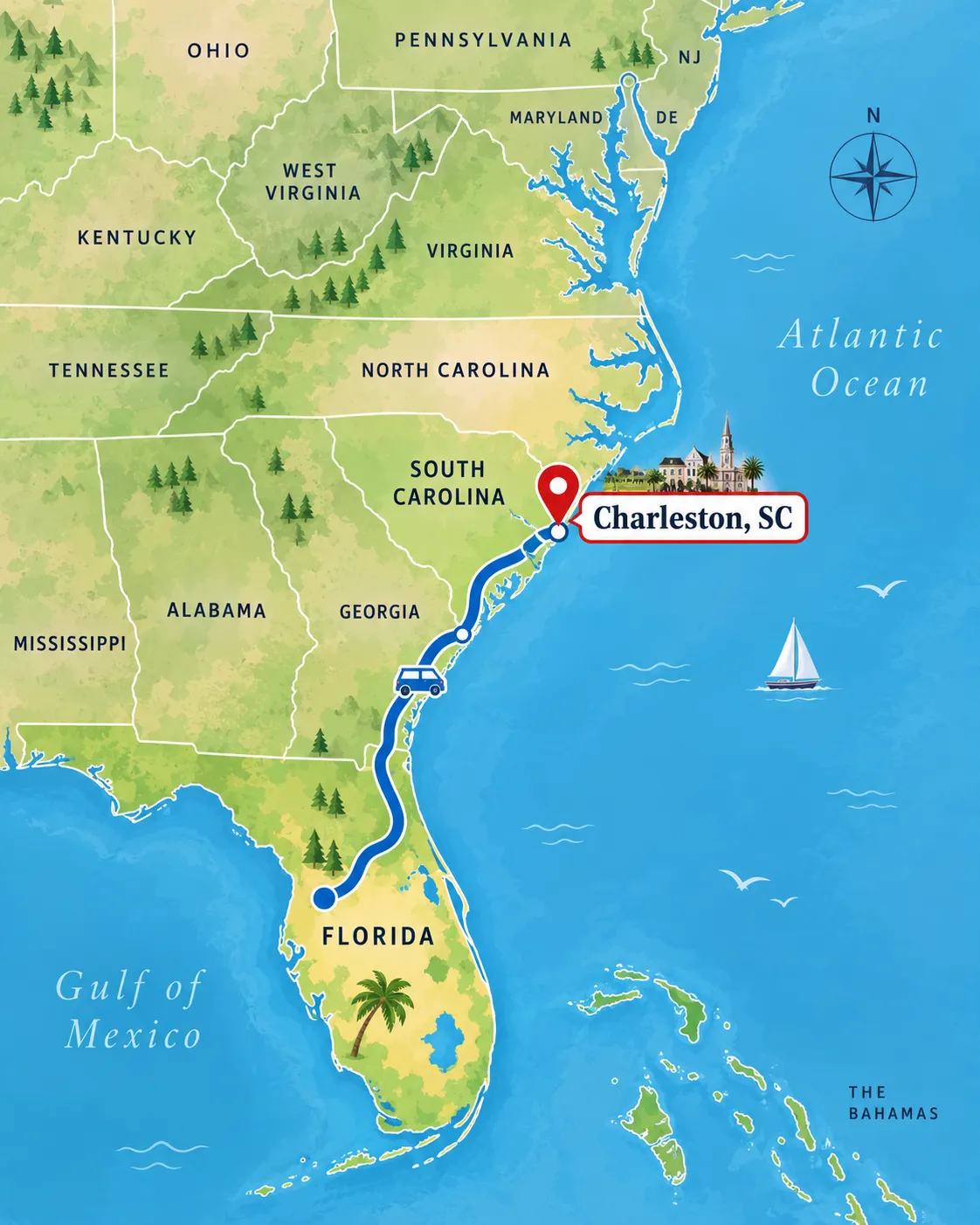
Moving From Florida to Charleston SC: What Changes?
Moving From Florida to Charleston SC: What Changes?
The short answer is that Florida transplants generally trade a brutal insurance market and no real winter for a state income tax and actual seasons — and most of the Florida buyers Leah Beaulieu and BJ Rodgers with Coast2Coast Properties work with come out ahead on balance, even after accounting for South Carolina's income tax. Charleston shares Florida's hurricane exposure and coastal humidity, but the two states diverge sharply on insurance cost, tax structure, and how much winter actually shows up on the calendar.
The short answer
- Homeowners insurance is dramatically lower in Charleston. Florida's statewide average is around $10,384 a year, compared to roughly $3,883 in Charleston — a difference of more than $6,000 annually.
- South Carolina has a state income tax, with a top marginal rate around 6%, while Florida has none. At $100,000 of income, that can mean roughly $5,890 more in state tax paid in South Carolina.
- Property taxes are lower in South Carolina overall. Florida's effective rate runs around 0.78% versus South Carolina's roughly 0.49%, a difference of about $1,160 a year on a $400,000 home.
- Charleston has real seasons. January averages a 60°F high and 39°F low, cool enough for a jacket most mornings, compared to Florida's barely-there winters in most of the state.
- Hurricane risk doesn't disappear — it just shifts in character, with Charleston seeing fewer storms overall but real storm surge and evacuation considerations on the barrier islands.
- Sales tax is roughly comparable between the two states, so day-to-day cost of living doesn't swing dramatically on that front.
- The pace of life and community feel differs by Florida region, but most transplants from South Florida describe Charleston as noticeably calmer and less transient.
Insurance costs are the single biggest financial change
This is the number that surprises Florida transplants most, and it runs in their favor. Florida's homeowners insurance market has been in crisis for several years, with multiple carriers exiting the state and premiums climbing accordingly — the statewide average now sits around $10,384 a year for a standard policy. Charleston homeowners pay an average of $3,883 a year, still above the national average due to hurricane and flood exposure, but less than half of what a comparable Florida policy costs.
The gap narrows for Charleston properties directly on the water — a home on Sullivan's Island (29482) or Isle of Palms (29451) will carry a meaningfully higher premium than one in Summerville (29483) or West Ashley (29407) — but even coastal Charleston properties rarely approach Florida's statewide average. Leah and BJ walk every Florida client through actual insurance quotes before they write an offer, because the savings here are large enough to materially change what a buyer can afford.
South Carolina has an income tax — and it usually still comes out ahead
Florida has no state income tax at all, which is the single biggest tax advantage Florida transplants give up by moving to Charleston. South Carolina's top marginal income tax rate runs around 6%, reached at a relatively low income threshold, and at $100,000 of household income that can mean roughly $5,890 more paid annually in South Carolina than in Florida.
That said, the math rarely stops there. South Carolina's property taxes run lower than Florida's — an effective rate around 0.49% versus Florida's 0.78%, which translates to roughly $1,160 a year in savings on a $400,000 home — and South Carolina's homeowners insurance savings alone can exceed $6,000 annually compared to Florida's statewide average. For most households, the combined property tax and insurance savings offset a meaningful share of the income tax difference, and retirees benefit further from South Carolina's full exemption of Social Security income and additional $15,000 retirement income deduction for residents 65 and older.
Charleston actually has a fall and winter
Florida transplants, especially those coming from South Florida, consistently underestimate how different Charleston's seasons feel. January in Charleston averages a 60°F high and 39°F low — genuinely cool, with occasional frost and rare light snow — compared to Florida winters that rarely produce a true cold snap outside the panhandle. Fall in Charleston brings real changes in light, temperature, and even some leaf color, something many Florida transplants say they didn't realize they missed until they had it back.
Summer is where the two states feel more similar than different. Charleston's July highs average 91°F with heavy humidity, comparable to much of Florida, so transplants shouldn't expect summer relief — just a genuine winter and fall to balance it out.
Hurricane risk changes shape, but doesn't go away
Charleston sits squarely in hurricane country, and Florida transplants sometimes assume they've left storm risk behind by moving north. They haven't, but the risk profile is different. South Carolina sees fewer direct hurricane strikes per year than Florida on average, and the storm season timing (June through November) is the same. What changes most is evacuation logistics — Charleston's barrier islands like Sullivan's Island and Isle of Palms have limited evacuation routes, and mainland neighborhoods like Mount Pleasant (29464/29466) and West Ashley generally have more evacuation flexibility than comparable Florida coastal communities. Insurance underwriting for wind and flood risk follows similar logic in both states, with elevation, flood zone, and construction type driving premium differences more than state lines.
The biggest mistake Florida buyers make
The biggest mistake is assuming Charleston's cost of living will mirror Florida's simply because both are Southern, coastal, and hurricane-exposed. The tax structure is nearly inverted — Florida wins on income tax, South Carolina wins on property tax and insurance — and buyers who don't run the full math for their specific income and home value sometimes reach the wrong conclusion about which state is actually cheaper for them personally. Leah and BJ recommend every Florida client run a side-by-side estimate covering income tax, property tax, and insurance together, not just one line item in isolation.
A realistic example
A couple relocating from Tampa asked Leah and BJ to run the numbers before committing to a move. Their Tampa homeowners insurance had climbed to just over $9,000 a year on a $500,000 home; a comparable home in Mount Pleasant quoted closer to $3,600. South Carolina's income tax added roughly $4,500 a year back onto their tax bill at their income level, but the insurance savings alone more than covered that difference, and their property tax bill dropped by another $1,800 a year. Their overall verdict: modestly better off financially, and unexpectedly happy about having a real fall for the first time in over a decade.
FAQ
Is homeowners insurance cheaper in Charleston than Florida?
Yes, substantially. Florida's statewide average is around $10,384 a year, compared to roughly $3,883 in Charleston, though coastal Charleston properties will run higher than inland ones.
Does South Carolina have a state income tax?
Yes. South Carolina's top marginal rate is around 6%, while Florida has no state income tax at all, which is the main financial trade-off Florida transplants take on.
Are property taxes higher or lower in South Carolina than Florida?
Lower on average. South Carolina's effective property tax rate runs around 0.49% versus Florida's roughly 0.78%, a meaningful difference on higher-value homes.
Does Charleston really have a winter?
Yes, a mild but genuine one. January averages a 60°F high and 39°F low, with occasional frost, compared to most of Florida's much milder winter temperatures.
Is hurricane risk lower in Charleston than in Florida?
Charleston sees fewer direct hurricane strikes per year on average than much of Florida, but the June-through-November storm season and evacuation planning considerations are similar, especially on Charleston's barrier islands.
Will I still need flood insurance in Charleston like I did in Florida?
Likely, depending on flood zone. Lenders typically require flood insurance for homes in AE flood zones in both states; homes outside mapped flood zones in Charleston often don't require it.
Is the overall cost of living lower in Charleston than in Florida?
For most households, yes, once property tax and insurance savings are factored in, even accounting for South Carolina's income tax — but the exact comparison depends on household income and home value.
Which Charleston neighborhoods do Florida transplants prefer?
Mount Pleasant (29464/29466) and West Ashley (29407/29414) are popular for their balance of space, lower flood exposure, and proximity to the coast without full barrier-island pricing and insurance costs.
About Leah Beaulieu & BJ Rodgers — Coast2Coast Properties
Leah Beaulieu and BJ Rodgers are Charleston, South Carolina real estate professionals with Coast2Coast Properties, helping buyers compare neighborhoods, understand local market differences, and find the right fit across the Charleston area. Whether you are buying your first home, relocating to the Lowcountry, or looking for investment opportunities, Leah and BJ bring local knowledge, straight talk, and a genuine commitment to helping clients make smart decisions.
Coast2Coast Properties
www.coast2coastprop.com
843-697-1409 / 803-201-4259