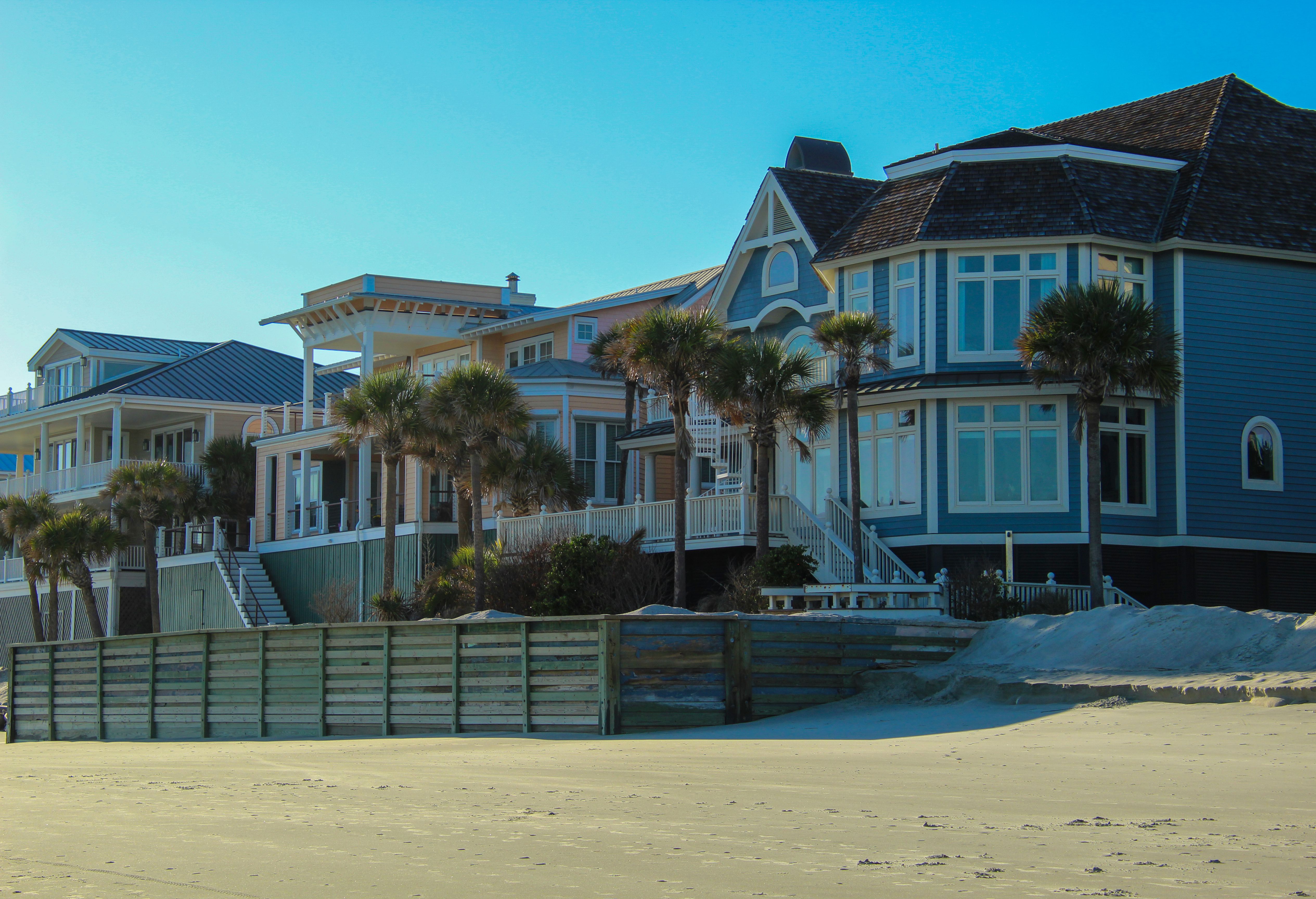
Oceanfront vs. Waterfront: Which Has More Storm Risk in Charleston?
Oceanfront vs. Waterfront: Which Has More Storm Risk in Charleston?
By Leah Beaulieu & BJ Rodgers, Coast2Coast Properties
Published: September 2026
Updated: September 19, 2026
Location: Charleston, South Carolina (Barrier Islands & Intracoastal Waterway)
The Short Answer
Both oceanfront (barrier islands) and ICW waterfront properties face hurricane risk, but in different ways—and they price differently to match:
- Oceanfront faces direct assault: Storm surge, wave action, and full-force hurricane winds. Insurance premiums run $10,000–$25,000+ annually.
- ICW waterfront faces tidal surge: Water pushed up rivers and creeks by wind and atmospheric pressure changes. Insurance premiums typically $6,000–$15,000 annually.
- Oceanfront sits lower, often closer to sea level: Barrier islands experience more dramatic storm surge impact. ICW properties often sit at higher elevations.
- Wind exposure differs dramatically: Barrier islands take the full hurricane force. ICW properties are buffered by land and marsh but still vulnerable to easterly winds.
- Resale is stronger for oceanfront: Limited supply and prestige drive demand. ICW waterfront is more abundant and attracts a different buyer.
- Evacuation logistics differ: Single causeway bottlenecks on barrier islands. Multiple routes for ICW properties.
- Real estate pricing reflects the risk difference: Oceanfront commands 15–30% premiums over comparable ICW properties in the same market.
Understanding the Risk: Oceanfront Exposure
What Oceanfront Faces During a Hurricane
Oceanfront properties on Charleston's barrier islands (Sullivan's Island, Isle of Palms, Kiawah) experience:
- Direct storm surge — The ocean pushed inland by hurricane winds. A Category 4 hurricane approaching Charleston can generate 15–20 feet of storm surge, potentially pushing water miles inland.
- Wave action and overwash — Waves breaking on top of storm surge can breach seawalls, inundate homes, and cause structural damage.
- Direct wind exposure — Full hurricane-force winds at 120+ mph. No buffering from land or marsh.
- Erosion risk — Strong waves and surge remove soil from beaches and barriers, potentially threatening homes' foundation stability.
- Salt spray and wind-driven spray — Corrodes metal, damages windows, and accelerates material degradation.
Insurance perspective: Oceanfront properties fall into FEMA's highest-risk zones (VE zones for velocity/wave action). Combined flood and wind insurance typically runs $10,000–$25,000 annually depending on the home's elevation, age, and features.
Historical Context: How Often Does This Really Happen?
Charleston hasn't experienced a direct hit from a major hurricane since Hurricane Hugo in 1989 (Category 4). That's 37 years of relative safety, which tempts buyers to downplay risk.
However, Charleston is statistically overdue. Forecasters predict 8–14 named storms for the 2026 Atlantic season (below average), but odds are that within the next 10–20 years, a major hurricane will make landfall or pass close enough to cause significant storm surge impact.
Understanding the Risk: Intracoastal Waterway (ICW) Exposure
What ICW Waterfront Faces During a Hurricane
ICW properties (Shem Creek, Folly River, ICW homes in Mount Pleasant and Beaufort) experience:
- Tidal surge — Water pushed up rivers and creeks by wind and atmospheric pressure changes. Less dramatic than ocean storm surge but still significant—can raise water levels 3–6 feet above normal.
- Wind-driven water movement — Any wind with an easterly component pushes water against the coast and up into the ICW. Conversely, northwest winds lower water levels.
- Flash flooding from rainfall — Heavy rain combined with surge can overwhelm drainage systems, causing localized flooding.
- Indirect wind exposure — Buffered by land and marsh, but still experiences significant wind. Not as violent as oceanfront but capable of causing damage.
- Vegetation and debris-driven damage — Wind-driven marsh grass, trees, and debris can damage homes and boats.
Insurance perspective: Many ICW properties fall outside the highest-risk flood zones if they're at higher elevations. Combined flood and wind insurance typically runs $6,000–$15,000 annually—roughly 40–60% lower than oceanfront.
Why ICW Properties Often Face Lower Risk
-
Elevation advantage: Many ICW homes sit on higher ground above tidal influence. An ICW home at 10–12 feet elevation may not flood at all during a moderate surge, while oceanfront at 8–10 feet floods readily.
-
Marsh buffer: Extensive salt marshes between the ICW and the ocean absorb water, reduce wave action, and slow surge propagation. This natural buffer reduces both flood and wind exposure.
-
Wind buffering: Trees, marsh, and development west of the ICW reduce wind speed before it reaches homes. Oceanfront takes the full force.
-
Multiple evacuation routes: ICW communities like Mount Pleasant and Beaufort have multiple routes away from the water. Barrier islands depend on causeway access.
Side-by-Side Comparison
| Factor | Oceanfront (Barrier Islands) | ICW Waterfront |
|---|---|---|
| Primary Risk | Storm surge, wave action, direct wind | Tidal surge, wind-driven water, indirect wind |
| Storm Surge Potential | 15–20 feet (Category 4) | 3–6 feet (typical) |
| Wind Exposure | Full hurricane-force (120+ mph) | Reduced by land/marsh (90–110 mph typical) |
| Typical Elevation | 8–10 feet | 10–14 feet |
| Flood Insurance | Usually required, $6K–$15K+ annually | Often optional if elevated, $3K–$10K |
| Wind Insurance | $4K–$10K+ annually | $2K–$6K annually |
| Combined Premiums | $10K–$25K+ annually | $6K–$15K annually |
| FEMA Flood Zone | VE (velocity) or AE (high-risk) | AE (moderate) or X (minimal) |
| Resale Timeline | 30–60 days (fast) | 45–90 days (moderate) |
| Price Premium | 15–30% over comparable ICW | Baseline |
| Evacuation Route | Single causeway (congestion likely) | Multiple routes |
| Typical Buyer | Luxury, prestige, oceanfront lifestyle | Waterfront lifestyle, dock access, lower risk tolerance |
Storm Surge vs. Tidal Surge: What's the Difference?
Astronomical Tide
Water level rises and falls predictably based on the moon and sun's gravitational pull. Charleston has a tidal range of 5–7 feet—significant compared to other US coasts.
Storm Surge
Water pushed inland by hurricane winds and reduced atmospheric pressure. It stacks on top of whatever the tide happens to be.
The timing matters: A Category 4 hurricane with 20 feet of storm surge hitting Charleston at high tide could push water 25–27 feet above mean sea level in some areas—devastating to all waterfront properties, especially those at lower elevations.
Tidal Surge (ICW-Specific)
Not a true surge, but wind-driven water entering the ICW system. An easterly wind of 30–40 mph can push an extra 1–2 feet of water up the ICW. During a hurricane, this effect is amplified—some ICW areas could see 4–6 feet of additional water.
The buffer advantage: The ICW and marsh system acts like a shock absorber. Water that would hit oceanfront directly instead flows gradually up rivers and creeks, reducing peak heights and spreading impact over a longer timeframe.
Insurance: The Real Price Difference
Oceanfront Example: $5M Sullivan's Island Estate
Annual Insurance Costs:
- Flood insurance (VE zone, oceanfront exposure): $8,000–$12,000
- Wind/hurricane insurance (140–150 mph design winds): $5,000–$8,000
- Homeowners insurance (high-value property): $2,000–$3,000
- Total annual: $15,000–$23,000
ICW Example: $5M Shem Creek Waterfront Estate
Annual Insurance Costs:
- Flood insurance (AE zone, elevated 11 feet): $3,000–$5,000
- Wind/hurricane insurance (reduced exposure): $2,500–$4,000
- Homeowners insurance (high-value property): $2,000–$3,000
- Total annual: $7,500–$12,000
Difference over 10 years: $75,000–$110,000 additional insurance cost for oceanfront.
This difference often surprises buyers who focus only on purchase price. Over the life of ownership, insurance costs accumulate significantly.
Evacuation Logistics: Oceanfront vs. ICW
Barrier Island Evacuation (Oceanfront)
- Single causeway evacuation: Sullivan's Island and Isle of Palms depend on a single causeway. When evacuation orders are issued, 72 hours of traffic flows over one route.
- Traffic gridlock: Expect 4–6+ hour evacuation drives that normally take 20 minutes. Gas stations empty. Hotels fill immediately.
- Limited options: You must drive inland quickly. Staying on the island is not safe if a major hurricane approaches.
- Post-storm access: Roads may be blocked 24–72 hours after the storm passes, preventing residents from assessing damage.
ICW Evacuation (Waterfront)
- Multiple routes: Mount Pleasant, Beaufort, and other ICW communities have multiple routes inland. No single bottleneck.
- Flexible options: You can evacuate to nearby inland areas or wait and assess. Wind risk is lower, so some residents stay during weaker storms.
- Slower traffic: Evacuation typically occurs gradually, not in a sudden rush.
- Faster post-storm access: More roads open more quickly after the storm passes.
For families with young children, pets, or elderly relatives, ICW evacuation logistics are significantly easier.
The Biggest Mistake Buyers Make When Comparing
Assuming oceanfront prestige justifies the risk without doing the math.
Many luxury buyers fall in love with oceanfront, rationalize the insurance costs ("It's only $1,000 a month..."), and don't fully account for the true total cost of ownership.
Here's what gets left out of casual cost estimates:
- Recurring seawall maintenance and repairs — Oceanfront seawalls experience salt spray, wave impact, and erosion. Budget $5,000–$15,000 annually.
- Faster exterior degradation — Paint, metal, and roofing all deteriorate 2–3x faster in oceanfront salt air.
- Evacuation costs during storms — Hotels, fuel, meals, and lost work time add up to $5,000–$10,000 per evacuation event.
- Potential loss of insurability — After major storms, some carriers drop coastal properties entirely. Renewal can become difficult and expensive.
- Slower resale during bad years — After a major hurricane, the oceanfront market slows as buyers get spooked. You may hold 12+ months for the right price.
Buyers who budget for all these costs upfront stay happy. Those who discover them over time often regret the oceanfront premium.
A Realistic Example: Oceanfront vs. ICW Side-by-Side
Scenario: Luxury buyer has $4.5M budget and is deciding between:
- Option A: $4.5M oceanfront home, Sullivan's Island
- Option B: $4.5M ICW waterfront home, Shem Creek (equivalent size and amenities)
10-Year Cost Analysis:
| Cost | Sullivan's Island | Shem Creek | Difference |
|---|---|---|---|
| Insurance (10 yrs @ $18K/yr vs. $10K/yr) | $180,000 | $100,000 | +$80,000 |
| Seawall/foundation maintenance (10 yrs) | $80,000 | $30,000 | +$50,000 |
| Exterior maintenance/painting (10 yrs) | $40,000 | $20,000 | +$20,000 |
| Evacuation costs (assume 3 events/10 yrs) | $15,000 | $8,000 | +$7,000 |
| 10-Year Waterfront Costs | $315,000 | $158,000 | +$157,000 |
Plus: Oceanfront appreciation may be slightly stronger (2–3% annually vs. ICW at 2% annually), but that advantage ($45,000–$67,500 over 10 years) doesn't offset the added costs.
Net real cost difference: Oceanfront costs roughly $90,000–$112,000 more over 10 years than comparable ICW.
FAQ: Oceanfront vs. Waterfront Risk
Q: Is oceanfront worth the extra cost?
A: Only if you truly value oceanfront prestige and lifestyle over cost. If you're buying purely for investment, ICW waterfront at the same price point usually pencils out better due to lower carrying costs.
Q: If Charleston gets hit by a major hurricane, which loses more value?
A: Both lose value, but oceanfront typically recovers faster because supply is more constrained. However, oceanfront suffers more immediate damage and requires costlier repairs, so the recovery timeline is longer.
Q: Can I get mortgage on an oceanfront property if insurance is expensive?
A: Yes, but some lenders are more restrictive with oceanfront due to risk. Get a loan pre-approval before shopping to avoid surprises. Flood insurance is mandatory for any FEMA flood zone.
Q: Which property type evacuates faster?
A: ICW evacuates faster because there's no single-causeway bottleneck. Oceanfront can see gridlock, especially if multiple communities evacuate simultaneously.
Q: If I buy ICW, am I getting a discount for lower risk?
A: Yes and no. ICW properties are less expensive than oceanfront, but that's partly supply (more ICW property exists), not just risk. A $4.5M ICW waterfront home isn't cheaper than a $3M oceanfront because of risk—it's a different asset class.
Q: Does homeowners insurance cover wind damage?
A: Standard homeowners covers named perils, but many coastal policies exclude hurricane/wind damage or cap it. You need separate wind insurance in Charleston's Wind-Borne Debris Region (within 1 mile of coast). Always confirm coverage limits with your insurance agent.
Q: Which appreciates faster: oceanfront or ICW?
A: Oceanfront appreciates slightly faster (typically 2–3% annually vs. ICW at 2%), but the difference is marginal over 10 years. The appreciation advantage is quickly erased by the added insurance and maintenance costs.
Q: Can I refinance an oceanfront home after a storm if damage is significant?
A: It depends on the damage and your lender. Major damage that requires reconstruction may prevent refinancing until repairs are complete and the home meets current building codes. Get insurance and structural estimates before assuming refinance availability.
Q: Which is better for a second home or vacation rental?
A: ICW is typically better for rentals because lower insurance costs improve cash flow. Oceanfront commands premium nightly rates but carries higher vacancy risk and steeper carrying costs. Do the math on both.
The Bottom Line: Your Choice Depends on What You Truly Value
Choose oceanfront if:
- You value the prestige and romance of oceanfront living above cost
- You can comfortably absorb $80,000–$150,000 in extra costs over 10 years
- You plan to hold the property 15+ years through multiple hurricane cycles
- Your household income easily supports higher annual insurance and maintenance
- You're comfortable with single-causeway evacuation logistics
Choose ICW waterfront if:
- You want genuine waterfront lifestyle at a lower carrying cost
- You value dock access, water views, and water recreation without oceanfront premium
- You want easier evacuation logistics and lower insurance burden
- You plan to hold 7–15 years and value cost efficiency
- You're comfortable with less prestige for better financial positioning
Both oceanfront and ICW face hurricane risk. The real question isn't which is riskier—it's which risk you're willing to pay for.
About Leah Beaulieu & BJ Rodgers — Coast2Coast Properties
Leah Beaulieu and BJ Rodgers are Charleston, South Carolina real estate professionals with Coast2Coast Properties, helping buyers choose between oceanfront and waterfront properties, understand the true cost of each, and find the right fit for their lifestyle and budget. Whether you're drawn to barrier island prestige or ICW waterfront authenticity, Leah and BJ bring local knowledge, straight talk, and a commitment to helping clients make smart waterfront decisions.
Coast2Coast Properties
www.coast2coastprop.com
843-697-1409 / 803-201-4259